
What size wire for 60 amps? Wire Gauge and Ampacity
For safe and effective electrical wire installation, we must use the correct wire size. Like for handling current flow in a 60 amp electrical circuit, there is a need for an accurate wire gauge. In this tutorial, we will cover details that help us select the right wire size for a 60-amp installation. Let’s start with a 60 Amp Wire Size—Which AWG is Best for a 60 Amp Breaker?
Understanding Wire Gauge and Ampacity
What is Wire Gauge?
American Wire Gauge, or AWG, also called wire gauge, is a standard method employed for finding wire diameter. There is an inverse relation between wire diameter and gauge number; a small gauge number indicates a larger wire diameter.
What is Ampacity?
The high value of current that safely carries without getting overheated and any damage is called ampacity. Using an accurate wire gauge and ampacity helps the wire carry current and manage load without affecting capacity. Here we have made a wire ampacity chart that helps to wire the ampacity of different wires.
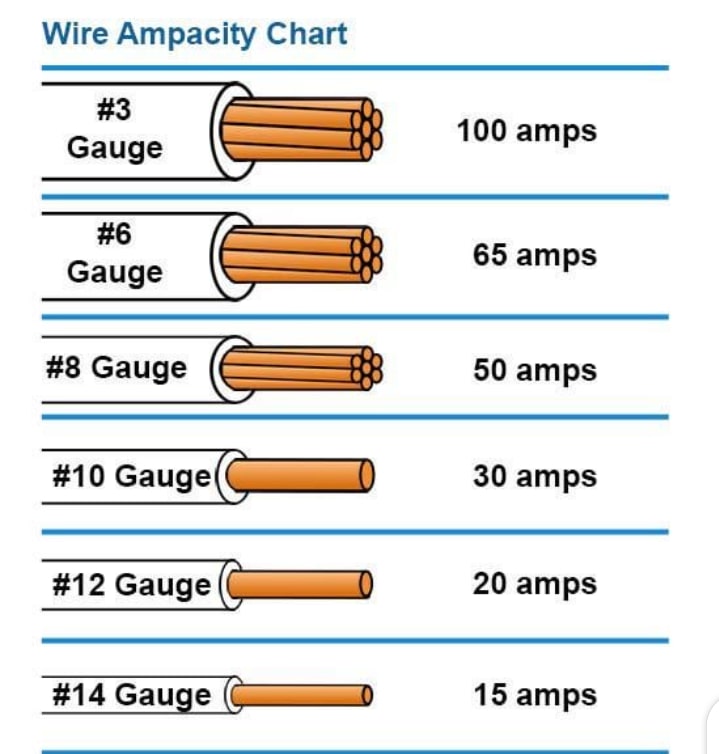
Copper Wire Ampacity Chart
| AWG Size | Ampacity (A) | Typical Uses |
| 14 AWG | 15 A | Lighting circuits |
| 12 AWG | 20 A | General outlets |
| 10 AWG | 30 A | Water heaters, dryers (some 120V) |
| 8 AWG | 50 A | Small subpanels, EV chargers (low power) |
| 6 AWG | 65 A | Ranges, large appliances |
| 4 AWG | 85 A | 100A subfeed (short runs with allowances) |
| 3 AWG | 100 A | Subpanels |
| 2 AWG | 115 A | Subpanels, service conductors |
| 1 AWG | 130 A | Service entrance |
| 1/0 AWG | 150 A | Service entrance |
| 2/0 AWG | 175 A | Service entrance |
| 3/0 AWG | 200 A | 200A service |
| 4/0 AWG | 230 A | 225–250A service |
Factors to Consider for 60-Amp Wire Sizing
Length of the Circuit
- Wire resistance changes with wire length, and a long wire provides high resistance. So a longer circuit needs a larger size for handling voltage losses.
Type of Wire Insulation
- The temperature rating for different wire insulation can be different. For the safety factor, the best is to choose a wire with insulation that can withstand a certain temperature value.
Ambient Temperature
- Wire temperature increases with high-temperature conditions. So the best thing is to consider the factor of where the wire is used so it does not affect the ampacity of the wire.
Allowable Voltage Drop
- The working of electrical tools is affected by high voltage loss. The best thing is that the set voltage losses are in the allowable range. Normally voltage loss value for some applications is 3% to 5%.
Recommended AWG
| Wire Gauge (AWG) | Ampacity (Amps) | Resistance (Ω per 1000 ft.) |
| 14 AWG | 15 | 2.525 |
| 12 AWG | 20 | 1.588 |
| 10 AWG | 30 | 0.999 |
| 8 AWG | 40-55 | 0.628 |
| 6 AWG | 55-65 | 0.395 |
| 4 AWG | 70-85 | 0.248 |
| 3 AWG | 85-100 | 0.197 |
| 2 AWG | 95-115 | 0.156 |
| 1 AWG | 110-130 | 0.124 |
Wire Size Recommendations for 60-Amp Circuits
Copper vs. Aluminium Wire
- Commonly used materials for electrical wires are aluminium and copper. Copper is more conductive than aluminium wire but is costly. So use materials for wire according to requirements.
Recommended Wire Gauge for Copper Wires
Based on circuit length, these wire gauges are used for a 60-amp copper wire circuit:
- 4 AWG for up to 100 feet
- 3 AWG for 100 to 150 feet
- 2 AWG for 150 to 200 feet
- 1 AWG for 200 to 250 feet
Recommended Wire Gauge for Aluminium Wires
According to the length of the circuit, these gauges are selected for 60-amp aluminium wire circuit
- 2 AWG for up to 75 feet
- 1 AWG for 75 to 125 feet
- 1/0 AWG for 125 to 150 feet
- 2/0 AWG for 150 to 200 feet
Safety Precautions and Installation Tips
Consult a Professional Electrician
Discuss with a certified electrician before electrical installation for a larger amp circuit. It gives details for installation and asks for safety requirements.
Circuit Breakers and Fuses
Use an accurate breaker for the protection of electrical circuits and tools. If there are electrical faults, provide safety precautions.
Secure and Label Wires
- Label the wire and strongly connect the wire at the time of installation. Proper labelling helps to maintain and troubleshoot the wire when needed.
Regular Maintenance
For electrical system maintenance, which is important for safety and effective features, perform regular inspections and maintenance on it.
How to calculate 60 amp wire size
To calculate wire size for a 60-amp circuit, follow the NEC (National Electrical Code) ampacity tables and work with rules like the wire size calculator rule, 80% rule, conductor type, and temperature rating.
80% Rule
Continuous load must not exceed 80% of breaker rating:
Required ampacity=600.8=75 amps
Conclusion
What size wire for 60 amps? For electrical installation in an effective and safe way, use an accurate wire size for a 60 amp circuit. For selection, different variables are considered, like wire gauge, ampacity, circuit length, and ambient temperature. Get advice from a qualified electrician and follow the correct installation procedures.
FAQs
Can I use a larger wire gauge than recommended for a 60-amp circuit?
- It is not recommended to use a wire gauge that is higher than a 60 amp circuit. Wires that are a larger size can increase high costs and also make installation difficult.
Is aluminium wire safe for 60-amp circuits?
- If it can be used if it exists in a limited range of ampacity limitations, aluminium wire can be used for 60-amp circuits.
What are the consequences of using undersized wires in a 60-amp circuit?
- Low-size wire causes overheating, voltage losses, and safety hazards for 60-amp circuits.
Can I run a 60-amp circuit outdoors?
- We can use a 60 amp circuit externally; make sure the wire has proper insulation and certification for external
Should I use a 2-pole or 3-pole breaker for a 60-amp circuit?
- 2-pole breaker is used for 60 amp circuit because it provides what is required and ensures the circuit’s effective protection.