
NiMH Battery Power Management for Embedded Systems: Voltage, Current, Charging & Stability Design Guide
Embedded systems powered by NiMH batteries often face unstable voltage behaviour, unexpected microcontroller resets, inaccurate state-of-charge readings, and inefficient charging cycles. Unlike lithium-based systems, NiMH cells operate with a nominal voltage of 1.2V and exhibit a relatively flat discharge curve, making system-level power design significantly more complex.
In real-world applications such as IoT devices, industrial controllers, and battery-powered sensors, improper power management can lead to system crashes, data loss, or reduced operational lifetime.
This guide explains how to design a stable embedded power system using NiMH batteries, covering voltage regulation, charging strategies, state-of-charge estimation, and firmware-level power optimisation.
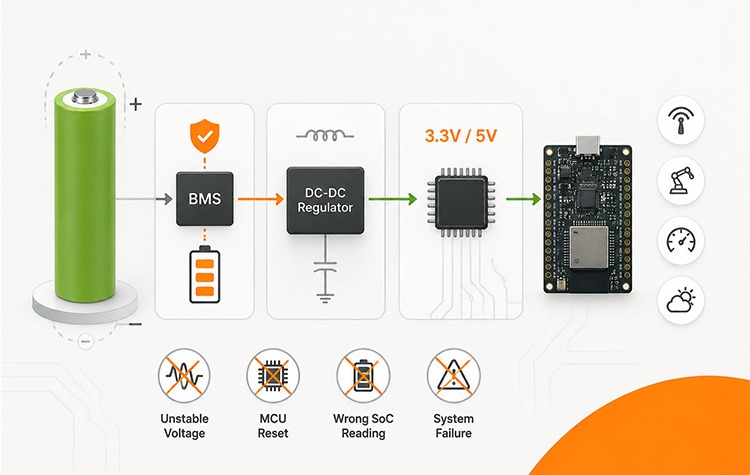
Why NiMH Batteries Behave Unpredictably in Embedded Systems
Many developers experience a common issue when using NiMH batteries in embedded systems: the device does not behave consistently under real-world load conditions. This is not a firmware bug—it is a power source behaviour problem.
Unlike regulated power supplies, NiMH battery voltage behaviour changes dynamically depending on load current, temperature, and discharge state. This makes system-level prediction extremely difficult in low-power designs.
Key technical challenges include:
- Voltage drop under load conditions causes unstable MCU operation
- Flat discharge curve leading to inaccurate SoC estimation
- High self-discharge rate affecting standby system reliability
- Internal resistance variation causing transient voltage dips
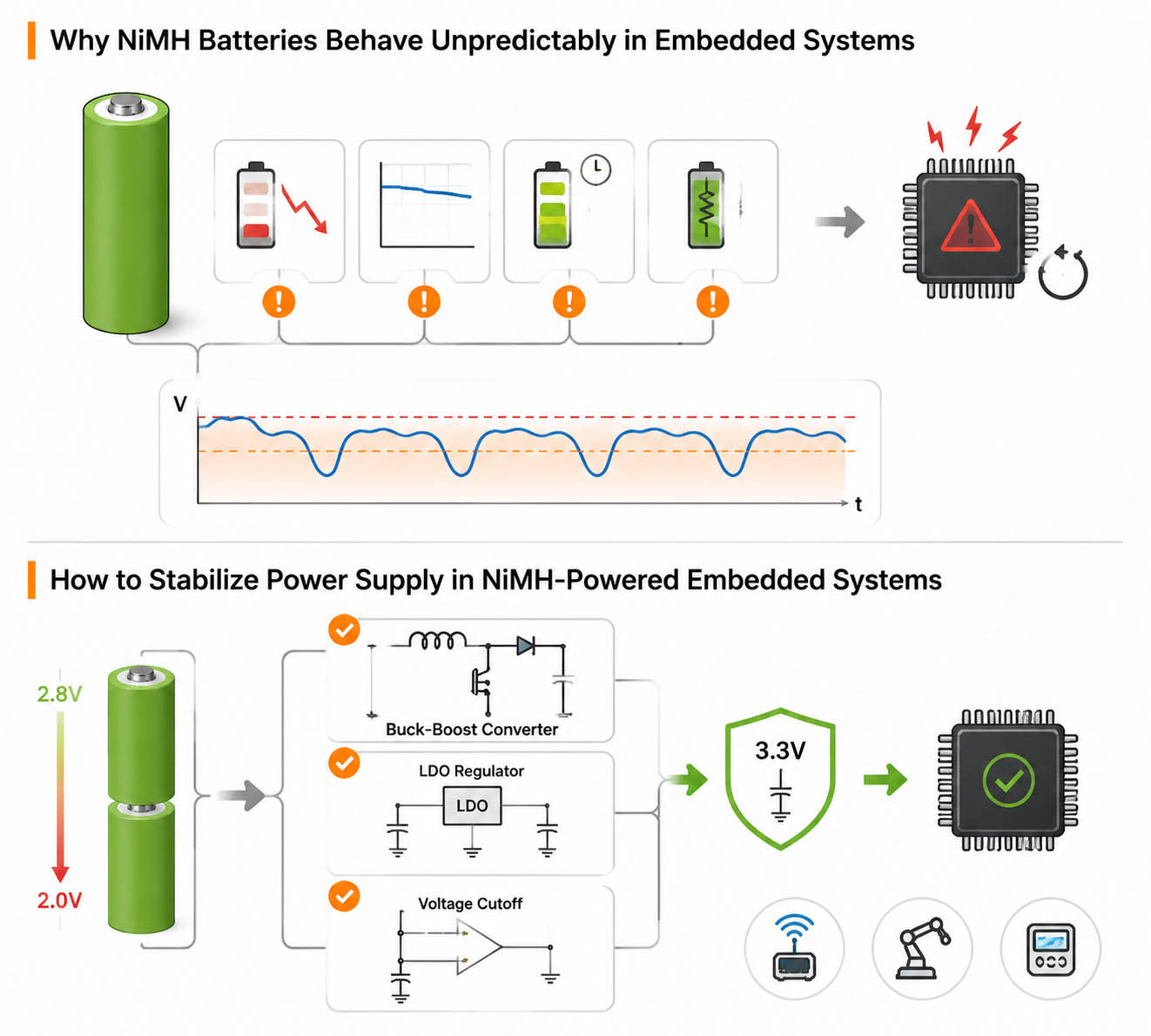
How to Stabilise Power Supply in NiMH-Powered Embedded Systems
A common failure mode in embedded systems is sudden resets or brownout conditions when using NiMH batteries. This usually happens because the system is directly exposed to fluctuating battery voltage without proper regulation.
To ensure stable operation, all embedded power systems using NiMH chemistry must implement proper voltage regulation between the battery pack and the MCU.
Recommended solutions include:
- Buck-Boost converters for stable 3.3V / 5V output in 2–3 cell systems
- Low Dropout (LDO) regulators for controlled step-down applications
- Voltage cutoff thresholds to protect the MCU from brownout reset
A typical 2-cell NiMH configuration ranges from 2.8V (fully charged) down to 2.0V (discharged). This variation is not suitable for most 3.3V microcontroller systems without regulation.
In industrial and IoT applications, engineers often simplify system design by using pre-configured NiMH battery packs that provide more stable voltage behaviour and reduce circuit complexity.
NiMH Battery Charging Strategies for Embedded Systems
Many users face a critical issue when working with NiMH batteries: the system overheats or battery life degrades much faster than expected. This is almost always caused by improper charging control in embedded designs.
Unlike lithium-based systems, NiMH batteries cannot tolerate continuous overcharging. Proper charge strategy must be strictly controlled at both hardware and firmware levels.
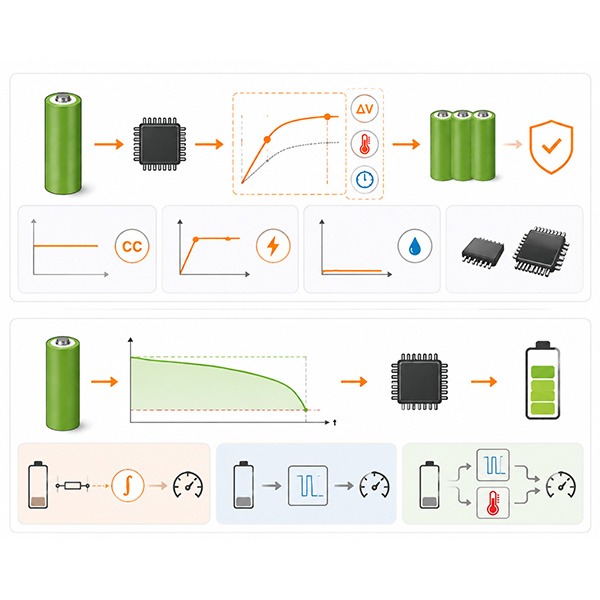
Key charging methods include:
- Constant Current (CC) charging for stable charge delivery
- Fast charging (0.5C–1.0C) for controlled high-speed charging
- Trickle charging (0.05C) for maintenance only
Charge termination is the most critical part of system safety. Embedded systems must detect:
- Negative Delta Voltage (-ΔV detection) when full charge is reached
- Temperature rise detection (dT/dt) to prevent overheating
- Timer-based fallback protection for safety redundancy
Recommended hardware solutions include MCP1630 charger reference design and MAX712 / MAX713 controller ICs for reliable charging control in industrial embedded applications.
Why NiMH Battery SoC Estimation is Difficult in Embedded Systems
A common frustration in embedded system design is inaccurate battery percentage readings when using NiMH batteries. Unlike lithium batteries, NiMH cells do not provide a linear voltage-to-capacity relationship.
During most of the discharge cycle, NiMH cells maintain a relatively flat voltage curve, which makes traditional voltage-based SoC estimation unreliable for real-world applications.
Recommended estimation methods include:
- Coulomb counting (current integration) for accurate capacity tracking
- Load-based estimation algorithms for dynamic system behaviour
- Hybrid firmware models combining voltage + current data
These methods allow embedded systems to estimate battery life more reliably under varying load conditions and improve system-level stability in industrial deployments.
Firmware Strategies to Extend NiMH Battery Life in Embedded Systems
If your embedded device is draining power faster than expected, the root cause is often not the battery itself, but inefficient firmware power management. In NiMH-powered systems, software design plays a critical role in extending operational lifetime.
Unlike lithium systems that rely heavily on hardware protection, NiMH battery systems depend on intelligent duty control and power-aware firmware design.
Key optimisation techniques include:
- Deep sleep / low-power modes to reduce idle consumption
- Duty cycling strategies for periodic wake-sleep operation
- Peripheral shutdown via MOSFET switching to eliminate leakage loads
- DMA offloading to reduce CPU active time
How to Choose the Right NiMH Battery Setup for Embedded Systems
Selecting the right NiMH battery configuration depends entirely on your application scenario, load behaviour, and system stability requirements. There is no one-size-fits-all solution in embedded power design.
For a deeper understanding of electrochemical behaviour and performance characteristics, refer to NiMH Batteries.
The recommended system configurations are:
| Application | Recommended Solution |
|---|---|
| IoT sensors | LSD NiMH + boost converter |
| Motor systems | high-drain NiMH pack |
| Standby devices | regulated battery pack |
| Industrial controllers | multi-cell pack + regulation |
Frequently Asked Questions
Why do embedded systems reset when using NiMH batteries?
This usually happens because NiMH batteries experience voltage drops under load conditions. When current demand spikes, internal resistance causes a temporary voltage dip, which may fall below MCU brownout thresholds and trigger system resets. Proper voltage regulation is required to prevent this issue.
Can NiMH batteries directly power microcontrollers?
Direct connection is not recommended. A single NiMH cell provides 1.2V nominal, and multi-cell packs fluctuate significantly under load. Most microcontrollers require stable 3.3V or 5V rails, so buck-boost converters or regulated power stages are required.
Why is NiMH SoC estimation inaccurate?
Because NiMH batteries have a flat discharge curve, voltage remains almost constant for most of the cycle. This makes voltage-based SoC estimation unreliable. Instead, engineers use coulomb counting to measure actual charge flow.
What is the best charging method for NiMH batteries?
The most reliable method is constant current charging combined with -ΔV detection or temperature-based cutoff (dT/dt). Without proper termination control, NiMH batteries may overheat and suffer long-term degradation.
Are NiMH batteries suitable for IoT devices?
Yes, but only when combined with proper low-power design. Using LSD NiMH cells, deep sleep modes, and regulated power rails significantly improves long-term IoT reliability.