
Full Turnkey PCB Assembly Guide: Process Control, BOM Sourcing, SMT Capabilities & Cost Optimization
Introduction
Delays and quality errors in different PCBA projects often arise from multiple factors rather than a single isolating manufacturing fault. In different electronics projects, manufacturing instability occurs due to improper collaboration between sourcing, manufacturing, assembly, testing, and logistics, compared to single technical faults
Common errors in PCB assembly projects include
- BOM shortages or long component lead times
- Inconsistent Gerber, BOM, and CPL files
- Incorrect component packages or footprints
- Unclear inspection plans for BGA or QFN devices
- Slow communication between multiple suppliers
- Unclear responsibility boundaries during troubleshooting
As PCB designs become compact and the parts supply chain becomes volatile, handling complete production phases with distinct vendors highly increases engineering overhead and project faults
So integrated manufacturing services are highly important for electronics companies making prototypes, complicated manufacturing assembly, and small-batch products.
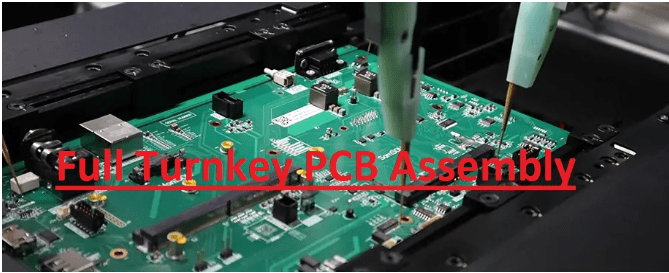
Full turnkey PCB assembly is not only about soldering components onto a PCB. It is an integrated workflow that connects PCB manufacturing, component sourcing, assembly, inspection, testing, and delivery.
A proper integrated turnkey process is helpful for reducing sourcing faults, manufacturing errors, engineering delays, and communication overhead across the complete supply chain.
What is Full Turnkey PCB Assembly
Full turnkey PCB assembly defines a complete manufacturing option where a single supplier works on the complete PCBA workflow from manufacturing to final shipment.
Typical turnkey services. The main steps are
- PCB fabrication
- BOM review and component sourcing
- SMT assembly
- Through-hole assembly
- SMT + THT mixed assembly
- BGA, QFN, and fine-pitch component assembly
- AOI and X-ray inspection
- ICT and functional testing
- Chip programming
- Packaging and delivery
Different advanced pcb assembly service providers supported flexible sourcing models for fulfilling different users’ demand and supply chain strategies.
Advanced modern PCB assembly providers are also compatible with different sourcing models, such as
- Full turnkey
- Partial turnkey
- Kitted/consigned assembly
A full turnkey manufacturer helps customers handle the complete PCBA process through a single coordinated manufacturing workflow.
This integrated process minimises engineering communication time while enhancing manufacturing consistency and traceability for complete production.
Files Required for an Accurate Turnkey PCB Assembly Quote:
Proper quotations based on complete and consistent manufacturing documentation. Well-prepared production files help companies perform faster engineering reviews, minimize clarification cycles, and enhance quotation accuracy.
Customers should provide:
- Gerber RS-274X / 274D files or PCB design files
- BOM with MPN, package, quantity, and reference designators
- Pick-and-place file / XY file / CPL file
- Assembly drawings
- Order quantity
- Testing requirements
- Special packaging or shipping instructions
Incomplete documentation causes engineering questions, quotation delays, and manufacturing faults.
For example:
- Missing package information can cause sourcing errors.
- Incorrect CPL coordinates may create placement problems.
- Outdated BOM revisions can lead to assembly mismatches.
- Missing testing instructions can limit verification coverage.
From an engineering perspective, file consistency is one of the important factors affecting manufacturing efficiency during prototype and quick-turn production.
Providing complete production data reduces EQ confirmation cycles and reduces version-control faults before production starts.
BOM Sourcing Importance
BOM sourcing is the main factor for turnkey PCB assembly since it affects lead time, manufacturing stability, and total project expenses.
Common sourcing risks are
- Incorrect MPNs
- Obsolete components
- Excessive MOQ requirements
- Long lead-time parts
- Unapproved substitutions
- Package mismatches
- Counterfeit or low-quality supply channels
In a full turnkey PCB assembly, BOM review should occur before manufacturing starts, not after the board is manufactured.
It is especially important for prototype and low volume projects where component availability finds delivery schedules more than PCB fabrication itself.
An effective BOM review is needed, synchronized through DFM and DFA analysis to find early sourcing and assembly faults.
Early sourcing verification also helps minimize unexpected redesign faults caused by unavailable or obsolete components.
For reliable manufacturing control:
- Alternative parts should always be confirmed by customers or engineering teams.
- Component lifecycle status should be checked before procurement.
- Long lead-time items should be identified during quotation.
- High-risk supply channels should be avoided.
- Package compatibility must be verified carefully.
DFM and DFA Review Before Assembly
DFM (Design for Manufacturability) and DFA (Design for Assembly) are the main steps in reducing production risk before assembly starts.
For high-density PCB designs, early DFM and DFA review helps to improve assembly yield and minimize expensive rework during later production stages
DFM Review
DFM reviews work on PCB production feasibility and process stability.
The main checks are
- PCB layer count
- Board thickness and copper thickness
- Minimum trace width and spacing
- Drill hole size and annular ring design
- Solder mask bridge capability
- Surface finish selection such as ENIG, HASL, or OSP
- Panelization strategy
- Fiducial marks
- Tooling holes
- HDI, flex PCB, and rigid-flex manufacturing risks
An accurate DFM review helps control manufacturing faults before the PCB enters manufacturing.
DFA Review
DFA review work on the assembly process reliability.
The main checks are
- Component package matching
- Clear polarity markings
- Adequate spacing for automated placement
- BGA and QFN inspection requirements
- Double-sided assembly reflow risks
- Test point accessibility
- Connector placement feasibility
A reliable turnkey assembly process is needed to find design, BOM, and assembly faults before manufacturing, not after.
Strong DFM and DFA workflows highly reduce rework, yield loss, and manufacturing delays.
PCB Fabrication affects on Assembly Reliability
PCB assembly quality does not start at the SMT line. It starts with PCB production quality.
Poor PCB manufacturing can cause main assembly faults such as the following:
- Solderability failures
- PCB warpage
- Via reliability issues
- Delamination
- Impedance instability
- Assembly alignment problems
Even advanced SMT equipment cannot fully compensate for unstable board fabrication quality or dimensional inconsistencies.
The main fabrication factors are
- Material selection
- Copper thickness
- Hole copper quality
- Solder mask consistency
- Surface finish quality
- Warpage control
- Panelization design
- Electrical testing
- AOI inspection
Modern electronics projects often need advanced PCB technologies such as the following:
- Flexible PCBs
- HDI PCBs
- High-frequency PCBs
- Rigid-flex PCBs
- Thick-copper PCBs
For projects needing fast delivery and flexible circuit features, quick turn flex PCB manufacturing services can help reduce development cycles while accommodating compact electronic designs.
PCB manufacturing quality directly affects solder joint reliability, assembly yield, and long-term product stability.
SMT, THT, BGA, and Mixed Assembly Capabilities
Advanced PCB assembly projects need both process features and the best production equipment.
As electronic products continue to become smaller and more complex, assembly precision and inspection features become increasingly important for manufacturing reliability.
Assembly Types
Modern turnkey assembly services are commonly compatible with
- SMT assembly with AOI inspection
- BGA assembly with X-ray inspection
- Through-hole assembly
- SMT and through-hole mixed assembly
- Lead-free RoHS soldering
These features are best for industrial, medical, automotive, communication, and high-density electronics products.
Equipment and Production Line Features
A professional PCB assembly facility is
- 3 high-speed SMT production lines
- Samsung and Yamaha SMT machines
- Automated pick-and-place systems
- Reflow ovens
- Wave soldering machines
- X-ray inspection equipment
- AOI testing systems
- Through-hole assembly lines
Manufacturing equipment quality strongly affects placement correctness, soldering consistency, and manufacturing throughput.
Stable process calibration and machine maintenance are also main factors for maintaining repeatable assembly quality during medium- and high-volume production.
Component Assembly Capability
Advanced high-density boards often need support for miniature and fine-pitch components, like
- 01005 passive components
- 0.38 mm fine-pitch ICs
- 0.3 mm pitch BGAs
- FPGA devices
- LGA packages
- DFN and QFN components
- Connectors and terminals
These chances are mainly for compact, high-density, and fine-pitch PCBA projects where soldering accuracy and inspection coverage affect reliability.
Inspection and Testing
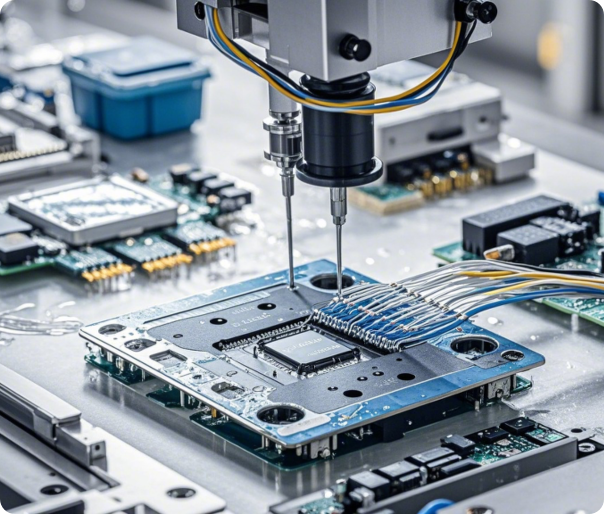
Inspection and testing are important for controlling assembly quality and minimising the chances of field failure.
In industrial and medical electronics, inspection coverage is directly connected to long-term product reliability and compliance requirements.
Inspection Methods
Common inspection and testing techniques are:
- AOI inspection
- X-ray inspection
- Voltage testing
- ICT testing
- Functional testing
- Chip programming
- Final visual inspection
Each inspection technique employed a different purpose during manufacturing
Testing Importance
AOI is effective for faults
- Missing components
- Polarity errors
- Component shifts
- Soldering defects
X-ray inspection is important
- BGA solder joints
- QFN hidden pads
- Voids and bridging detection
ICT and functional testing help verify:
- Electrical continuity
- Signal integrity
- Functional performance
- Power-up behavior
If customers do not give functional testing details, suppliers can perform only a basic inspection instead of complete product validation.
Inspection and testing needed to be planned before manufacturing, especially for BGA, fine-pitch, medical, industrial, and communication electronics.
Lead Time and Production Range
Lead time is based on both manufacturing capability and supply chain coordination.
Production Range
Modern turnkey assembly suppliers commonly support:
- Prototype production
- Small-batch production
- Medium-volume manufacturing
- Mass production
Typical order quantities range from:
- 5 pcs to 100,000 pcs
This flexibility helps provide product development from prototype validation to commercial production.
Assembly Lead Time
main assembly timelines are
- Assembly lead time from 8 hours to 72 hours when parts are ready
- Rapid prototype projects commonly completed within 3–7 working days
- Standard batch production is commonly completed within 10–15 working days, based on BOM complexity and part availability
Quick-turn PCBA is based not only on assembly speed, but also on BOM readiness, file accuracy, testing clarity, and supplier coordination.
Even highly automated assembly lines cannot compensate for incomplete engineering documentation or unstable component supply.
Cost Engineering and Optimisation Strategy
Cost optimisation in turnkey PCB assembly needs to balance manufacturing efficiency, sourcing stability, and product reliability.
Main Cost Drivers
main cost factors are
- PCB layer count and board size
- Material type
- Copper thickness and surface finish
- BOM cost
- SMT placement quantity
- BGA and fine-pitch component count
- Double-sided assembly
- Through-hole and hand-soldering workload
- AOI, X-ray, ICT, and FCT requirements
- Tooling and fixtures
- Expedited lead time
- Shipping method
Complex assembly features can significantly increase manufacturing costs if not managed carefully during design review.
Optimization guidelines
To improve manufacturing efficiency and minimize net project cost:
- Provide complete Gerber, BOM, CPL, and assembly files early
- Prefer stable and widely available components
- Reduce unnecessary unique part numbers
- Consolidate identical component specifications
- Reserve sufficient testing points
- Confirm acceptable alternative parts in advance
- Perform DFA review on BGA and fine-pitch areas
- Validate designs through prototype runs before mass production
The lowest assembly quote does not always result in the lowest total production cost if it increases sourcing risk, assembly defects, testing failures, or rework expenses.
Effective cost engineering works on total manufacturing reliability rather than unit price alone.
How to Choose a Full Turnkey PCB Assembly Supplier
Choosing the accurate PCB assembly partner needed evaluating both technical capability and supply chain management.
Important considerations are
- In-house PCB fabrication and PCB assembly capability
- BOM sourcing support
- Support for full turnkey, partial turnkey, and kitted assembly
- SMT, THT, BGA, and mixed assembly capability
- 01005 and fine-pitch assembly experience
- AOI, X-ray, ICT, and FCT testing capability
- Flex PCB, rigid-flex PCB, HDI PCB, and metal core PCB support
- DFM and DFA engineering review capability
- Prototype, low-volume, and medium-volume production support
A reliable turnkey service supplier should offer clear engineering communication, transparent sourcing control, and stable manufacturing processes throughout the project lifecycle.
Conclusion
Most PCBA project faults do not occur with a single process error but with poor coordination of designing files, BOM sourcing, board manufacturing, assembly, inspection, and testing.
The value of full turnkey PCB assembly does not minimize the communications workload. its main features lie in the improvement of process control, minimizing engineering faults, and increasing manufacturing consistency across the complete production cycle.
For prototype, quick-turn, low-volume, and high-complexity projects, integrated manufacturing collaboration is highly important.
Equipment features, process control, inspection coverage, and BOM management have an effect on final product quality and delivery.
Companies are getting integrated manufacturing partners that are compatible with PCB manufacturing, component sourcing, SMT assembly testing, and turnkey PCBA workflows. FastTurn PCB offers comprehensive end-to-end PCB manufacturing and assembly services for a wide range of electronic applications, helping users streamline sourcing, production, and delivery within a single coordinated workflow.