
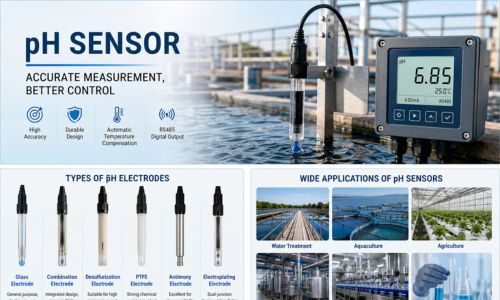
pH Sensors: Types, Uses, and How to Choose the Right One
Water quality affects almost everything around us — from the food we eat and the crops we grow to industrial manufacturing and environmental safety. One small change in water chemistry can create major problems in production systems, agriculture, aquaculture, or even drinking water treatment. That is why pH monitoring has become such an important part of modern industries.
A reliable pH sensor helps measure whether a liquid is acidic or alkaline, making it easier to maintain stable and safe conditions. Today, these sensors are used everywhere: laboratories, wastewater treatment plants, fish farms, hydroponics systems, pharmaceutical factories, and chemical industries all rely on accurate pH measurement.
This article is sponsored by Renkeer, a company that specialises in environmental monitoring and water quality sensing technologies.
Over the years, Renkeer has developed a wide range of monitoring solutions for industries such as agriculture, wastewater treatment, aquaculture, environmental research, and industrial automation. Their products include pH sensors, dissolved oxygen sensors, conductivity meters, soil monitoring devices, and IoT-based environmental monitoring systems.
What Is a pH Sensor?
In simple terms, a pH sensor is a device used to measure how acidic or alkaline a liquid is. The reading is shown on the pH scale, which ranges from 0 to 14.
- A value below 7 indicates acidity
- A value above 7 indicates alkalinity
- A value of 7 is considered neutral
The sensor works by detecting hydrogen ion activity inside a solution and converting that chemical activity into an electrical signal that can be measured and displayed.
Even though the concept sounds simple, pH measurement plays a major role in many industries. For example, if the pH level in a water treatment plant becomes unstable, it can damage pipelines, reduce chemical efficiency, and even make the water unsafe.
Why Accurate pH Measurement Matters
Many people assume pH monitoring is only important in laboratories, but that is far from true.
In agriculture, soil pH directly affects how well crops absorb nutrients. In aquaculture, even small pH fluctuations can stress or kill fish. Industrial facilities use pH monitoring to prevent corrosion, improve production quality, and reduce chemical waste.
Poor pH control can also increase maintenance costs. Equipment exposed to highly acidic or alkaline liquids tends to wear out faster, leading to expensive repairs and downtime.
That is one reason industries are increasingly investing in smart monitoring systems with real-time sensing capabilities.
The 4 Main Types of pH Sensors
Not all sensors are built for the same environment. Choosing the correct type depends on where and how the sensor will be used.
1. Combination Sensors
Combination sensors are probably the most commonly used type today. They combine the measuring electrode and reference electrode into a single compact body.
Because of their simple structure and easy installation, they are widely used in:
- Laboratories
- Aquaculture systems
- Water treatment
- Agriculture
They are also relatively affordable and easy to maintain.
2. Laboratory-Grade Sensors
These sensors are designed for precision work where highly accurate readings are necessary.
Compared to industrial probes, laboratory sensors are usually lighter, more sensitive, and optimized for controlled environments. Researchers and laboratory technicians often prefer them because they respond quickly and provide highly stable readings.
Typical applications include:
- Scientific research
- Pharmaceutical testing
- Chemical analysis
- Educational laboratories
3. Industrial Process Sensors
Industrial environments can be harsh. Sensors may be exposed to chemicals, sludge, pressure, heat, or continuous operation for months at a time.
Industrial process sensors are designed specifically for these conditions.
They usually feature:
- Strong protective housing
- Corrosion resistance
- Automatic temperature compensation
- Support for RS485 or analogue outputs
These sensors are commonly found in wastewater plants, chemical factories, cooling towers, and manufacturing facilities.
4. Differential Sensors
Differential pH sensors are designed to reduce contamination problems that often affect standard electrodes.
Instead of relying on a traditional reference design alone, they use additional electrodes to improve stability and reduce fouling.
These sensors are especially useful in:
- Dirty wastewater
- Mining operations
- Heavy industrial applications
- Chemical processing plants
Although they are usually more expensive, they often require less maintenance over time.
5. Antimony Electrode
Antimony electrodes use metallic antimony for sensing.
Advantages
- Strong corrosion resistance
- Suitable for hydrofluoric acid environments
- Durable in aggressive chemicals
Applications
- Highly corrosive industrial solutions
6. Electroplating Electrode
Electroplating electrodes feature dual-junction technology.
Advantages
- Reduced contamination
- Extended service life
- Stable measurements
Applications
- Electroplating wastewater
- Fermentation systems
- Organic-rich solutions
Applications of pH Sensors
pH sensors are used in many industries and scientific fields.
- Water Treatment: Used to monitor drinking water and wastewater quality.
- Agriculture: Helps maintain proper soil pH for crop growth.
- Aquaculture: Ensures safe water conditions for fish and aquatic organisms.
- Food and Beverage Industry: Maintains taste consistency and product safety.
- Pharmaceuticals: Controls chemical reactions and drug formulation processes.
- Swimming Pools: Maintains safe and comfortable water quality.
- Chemical Manufacturing: Used for process control and corrosion prevention.
Why is the pH Sensor Important?
pH sensors are essential because incorrect pH levels can cause serious problems in industrial systems, agriculture, and environmental ecosystems.
Key Reasons
- Water Safety: Unsafe pH levels can make water harmful for humans and aquatic life.
- Industrial Efficiency: Correct pH helps improve chemical process efficiency and product consistency.
- Corrosion Prevention: Improper pH levels can damage pipes, tanks, and industrial equipment.
- Environmental Protection: Wastewater must meet environmental standards before discharge.
- Agricultural Productivity: Proper soil pH improves nutrient absorption and crop growth.
Industries rely heavily on accurate pH monitoring to maintain operational safety and reduce maintenance costs.
Advantages of pH Sensors
Modern pH sensors offer many benefits.
- High Accuracy: Provides precise measurement of acidity and alkalinity.
- Real-Time Monitoring: Allows continuous monitoring in industrial systems.
- Automation Support: Can integrate with PLCs, IoT systems, and SCADA platforms.
- Wide Application Range: Suitable for laboratories, agriculture, water treatment, and industrial automation.
- Improved Safety: Helps prevent a dangerous chemical imbalance.
- Reduced Operational Costs: Early detection of pH issues prevents equipment damage and production losses.
- Easy Integration: Modern sensors support digital communication protocols and remote monitoring systems.